
Pushing the Limits of Large-Scale Route Optimization
After demonstrating strong performance on classical CVRP benchmarks and multiple VRP variants, we put TQrouting to the ultimate test: the CVRPLib Best-Known Solutions (BKS) Challenge. Competing head-to-head with leading global solvers on instances of up to 10,000 customers, we showcased its performance at the frontier of large-scale routing.
In this article, we share our experience participating in the CVRPLib BKS Challenge: why we entered, how the competition unfolded, and what our results reveal about TQrouting’s ability to solve extremely large routing problems at the frontier of current optimisation research.
What is the CVRPLib BKS Challenge and Why We Entered?
CVRPLib BKS Challenge 2026, organized by CVRPLib, was the premier global benchmark arena for large-scale Capacitated Vehicle Routing Problems (CVRP). It invited leading researchers from both academia and industry to benchmark their solvers, improving the best-known solutions for the public XL benchmark dataset, which contains new large-scale CVRP instances.
The BKS Challenge cuts through claimed performance and tests it under transparent, competitive conditions. Solvers are tested head-to-head against the world's strongest algorithms, pushing the boundaries of what is computationally possible. We joined for exactly this reason.
The CVRPLib BKS Challenge 2026 introduced a new XL benchmark set, shifting the focus toward CVRP problems with up to 10,000 customers, problem sizes that stress not only algorithmic design but also hardware infrastructure and system robustness.
We already published benchmark results on CVRP at scale and on multiple VRP variants. This time, we demonstrated TQrouting’s performance in the toughest open setting available: against top academic approaches and industrial solvers, on large instances that resemble real enterprise logistics.
The Challenge in Numbers
Over 30 days, multiple teams worldwide, from academia, industry, or both, ran massive parallel computations. In total, 19 teams were approved to participate. It was possible to opt for a “hidden registration,” allowing teams to participate anonymously; their data remained private unless they submitted at least one new BKS during the competition.
The XL benchmark dataset consists of 100 new large-scale CVRP instances with between 1,000 and 10,000 customers. Instances vary not only in problem size but also in attributes such as depot and customer positioning, demand distributions, and average route size, systematically covering a wide range of instance structures.
BKS visualisations of selected instances below illustrates the structural variety within the XL dataset: different depot placements, demand distributions, and route configurations.

Behind the Scenes: 30 Days at the Edge of Computation
This was not a static leaderboard. Throughout the challenge, solutions evolved continuously as teams refined search strategies, tuned algorithm parameters, and launched new long-running jobs. Despite this global effort, improvements remained incremental and highly competitive. Several instances saw BKS updates multiple times per day over weeks, even until the very end of the challenge, providing clear evidence of the enormous search spaces involved. In fact, TQrouting set its last BKS just 42 minutes before the official deadline, underscoring how open-ended these problems truly are.
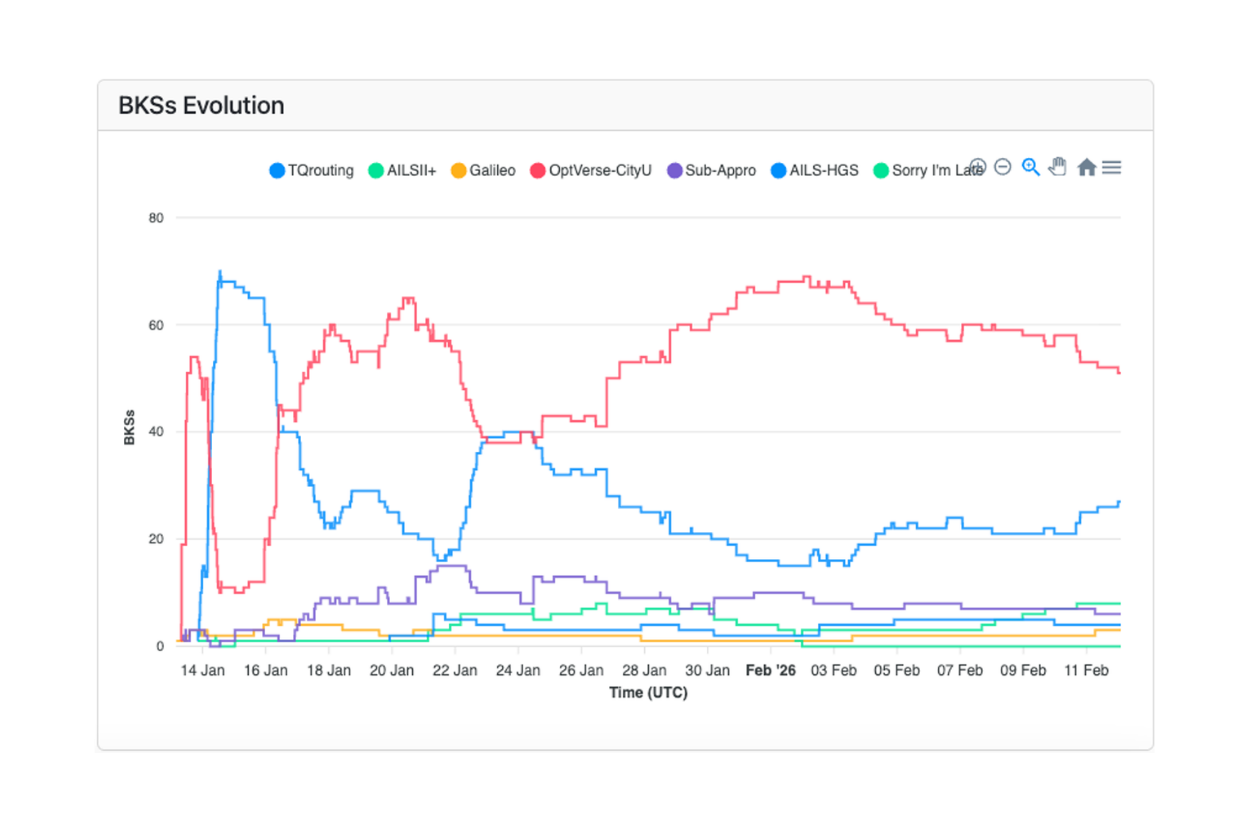
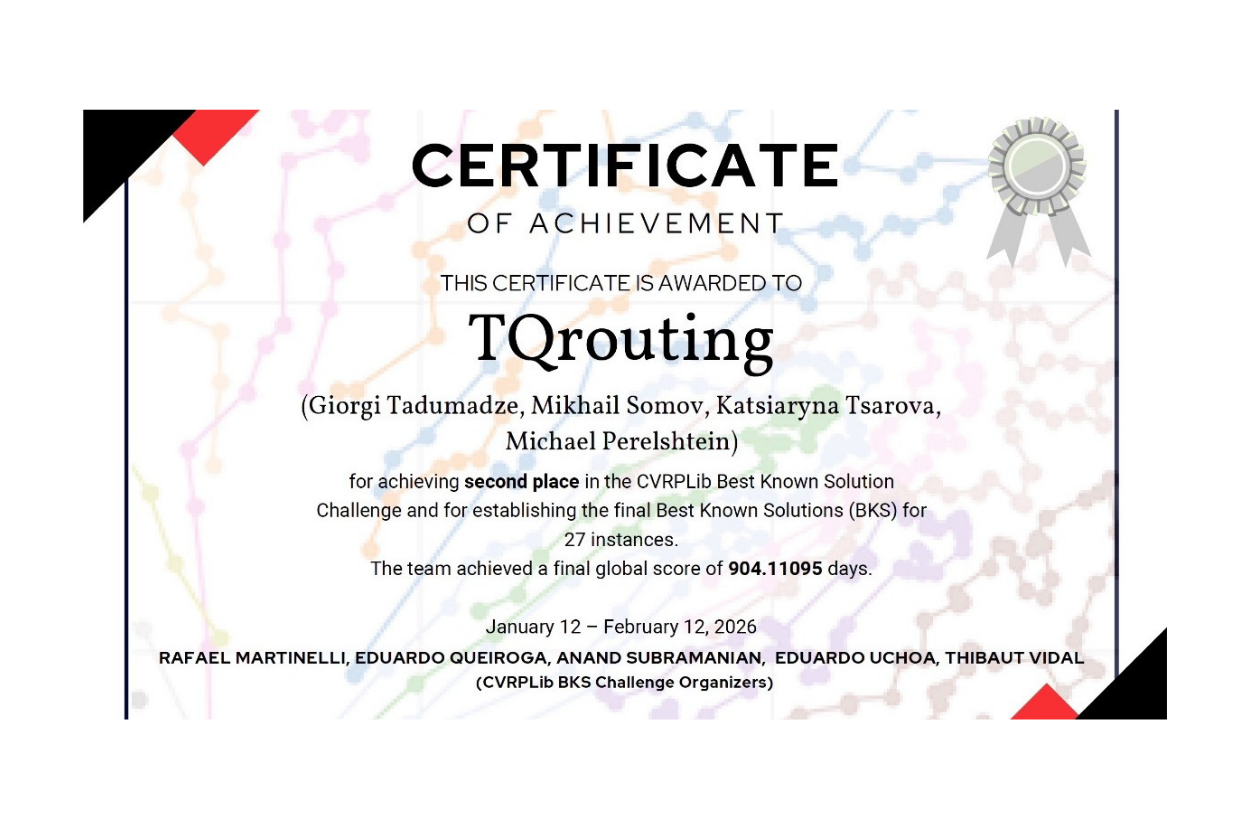
In the final leaderboard, TQrouting achieved BKSs for 27 out of 100 instances. Its results were exceptional on large-scale instances, exactly what TQrouting was designed for, holding 7 of the 10 largest instances, including three of the largest problems, ranging from 9,570 to 10,000 customers.
These are precisely the instance sizes where many solvers begin to struggle with memory limits, convergence stability, or diminishing returns, making them especially relevant for large fleet operators. TQrouting’s ability to consistently improve solutions at this scale highlights its robustness under extreme conditions, representing the same regime faced by operators managing thousands of daily deliveries.
TQrouting finished in second place overall. The result was formally recognised by the challenge organizers:
Why Benchmark Challenges Like This Matter
The XL benchmark dataset represents today’s frontier of routing optimisation. Dozens of teams simultaneously explored these instances, leveraging extensive parallelisation and advanced metaheuristics. Real-world routing problems involve far more constraints than classical CVRP: time windows, multiple depots, heterogeneous fleets, driver regulations, service priorities, and more. Yet CVRP remains the core building block of most VRP formulations.
At its heart, CVRP combines two of the hardest combinatorial challenges:
• Partitioning: deciding which customers belong to which vehicle.
• Permutation: determining the visit order within each route.
Together, these create enormous search spaces even before additional constraints are introduced. Progress in solving large-scale CVRP directly advances the foundations of modern VRP solvers. In practice, a robust CVRP engine is the cornerstone of a powerful route-optimisation platform. Once that core is in place, additional objectives and constraints can be layered effectively, provided the architecture is modular and scalable, as TQrouting is.
This is why challenges like the CVRPLib BKS matter. Beyond ranking state of the art algorithms, they push the state of the art forward. The best-known solutions established here become reference points for future research and the next generation of optimisation algorithms. That's ultimately what motivated our participation: the work done in these settings has real consequences for how routing problems get solved in practice.
From Benchmarks to Business Impact: What's Next?
The XL instances tackled in this challenge resemble the computational complexity faced by large fleet operators: thousands of stops, tight constraints, and limited planning windows. Performance at this scale directly translates into operational value:
• Fewer driven kilometres
• Lower fuel consumption and emissions
• Better-balanced routes
• Improved on-time delivery
• Higher fleet productivity
Even a single-digit percentage improvement in routing efficiency can mean millions in annual savings for large logistics networks. In our next article, we shift from benchmarks to business: sharing a parcel-delivery case study with real operational constraints, showing what efficiency gains look like in practice.
If you’d like to explore how TQrouting could support your operations, contact us to learn more or request a demo.