
Why a Public Signal Matters
Progress toward breaking public-key cryptography was scattered across private labs, vendor roadmaps, classified research, and academic papers. There was no single public signal of what was actually possible at the time.
When we introduced the Breaking RSA challenge with qBitTensor Labs in June, the aim was to close part of that gap. The challenge sets progressive factorization milestones on qBitTensor Labs' Enigma platform, verifies each result on multiple validators, and publishes every winning solution in the open. Cryptanalytic capability becomes something you can measure rather than guess at.
The challenge is one input among several, alongside expert surveys, vendor roadmaps, and academic research. It is also the one that shows publicly demonstrated capability with the least ambiguity. Terra Quantum supports the challenge as a technical reviewer.
The challenge now works as two instruments. Its classical milestones are a clock, showing how fast factoring is improving. Its new 1024-bit milestone, which qBitTensor Labs plans to open to quantum hardware, is a tripwire.
The Clock: Classical Factoring Is Speeding Up
Every Breaking RSA entry runs on the same validator hardware: one NVIDIA RTX PRO 6000 GPU, 24 vCPUs, no network access, and four hours. Each entry is tested on freshly generated numbers, so answers can't be precomputed.
Within that fixed budget, the milestones have climbed quickly. The first milestone fell overnight after the challenge opened in early June. An entry built around a GPU lattice siever took the 460-bit milestone in 3.9 hours, and the 480- and 500-bit milestones followed by early September. By early October, entrants had also broken the 512-bit milestone and the 530-bit milestone after it. The 560-bit milestone has fallen since, and the next target is 580 bits.
The 512-bit result matters because RSA keys of that size were widely used in the 1990s. A 2015 study needed a cluster of cloud computers and $75 to factor one in under four hours. The challenge's winning entry does it within the same four hours on a single machine, for under $10.
The wider classical frontier has moved too, and suddenly. RSA-250, an 829-bit number factored in February 2020, stood as the largest RSA challenge number factored for more than six years. Then two records fell in 16 days: Eric Lu of Cognition factored RSA-260 (862 bits) on September 3, and Stephen Weis factored RSA-896 (896 bits) on September 19.
Neither result needed a new algorithm. Both ran the general number field sieve, the method behind every general-purpose factoring record since the mid-1990s, through GPU ports of the open-source CADO-NFS software. Both ports were built with AI coding agents: Devin in Lu's case and Claude in Weis's. Lu reports that his GPU version cut the cost of factoring roughly tenfold, where every earlier record had run its sieving on CPUs.
AI and GPUs reinforced each other twice over. AI agents wrote the GPU code, and spare capacity on large GPU clusters supplied the compute.
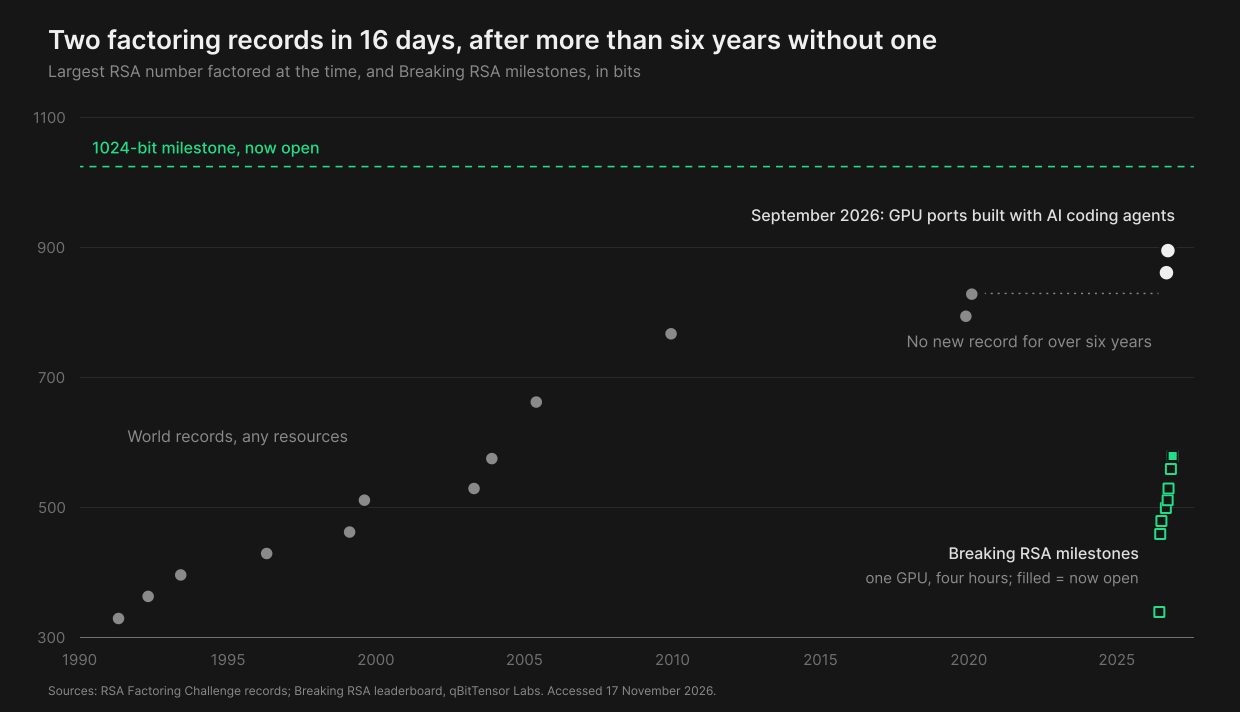
Figure 1. The challenge's one-GPU, four-hour milestones have reached 560 bits, beyond RSA-160, the 530-bit general-purpose factoring record set in April 2003. Milestone dates are approximate. Sources: RSA Factoring Challenge records (Wikipedia, Cognition, Stephen Weis); Breaking RSA milestones (qBitTensor Labs)
This is how cryptanalytic progress tends to arrive: long stretches of incremental improvement, then a step change. This step matters. Lu estimates that factoring RSA-1024 would now cost about $30 million at market GPU prices, putting 1024-bit keys, deprecated since 2013, within reach of well-funded attackers. RSA-2048 is a different matter. By Lu's estimate, it remains roughly a billion times harder than RSA-1024. At the top end, the threat that matters is quantum.
The Tripwire: Quantum Hardware Will Enter at 1024 Bits
The challenge's most significant milestone yet is now open: a 1024-bit target, backed by a $250,000 bounty from qBitTensor Labs and paid under its competition rules.
Classical methods can't reach that target within the challenge's fixed budget. Lu's estimate of about 1,050 GPU-years for RSA-1024 is more than two million times what one GPU does in four hours. This is where quantum hardware will enter. Through the Open Quantum platform, qBitTensor Labs plans to give entrants access to real quantum processors from providers including IonQ, Rigetti, and IQM, so they can bring hybrid classical-quantum approaches to the target.
The hybrid framing is deliberate. A purely quantum challenge isn't practical today: as Craig Gidney of Google Quantum AI has pointed out, the published quantum factorings of 21 have all relied on circuits simplified using knowledge of the answer, and nobody expects today's hardware to break this milestone. That isn't the aim. The aim is to draw novel approaches to a hard target and to record any genuine contribution from quantum resources in public, with results anyone can verify. If quantum hardware starts to contribute something real to factoring, this is one place it can show up in the open.
Once quantum access opens, Terra Quantum will provide technical review of quantum-based submissions, with a single purpose: keeping the signal honest.
AI Is Accelerating the Quantum Side, Too
The reason AI coding agents could move the classical record so quickly is that every idea can be checked cheaply. Run the code, and the factors either multiply out or they don't. Much of quantum computing has the same property. A new error-correcting code, decoder, or gate design can be tested in simulation long before it runs on hardware, so AI can propose ideas by the thousand and keep only the ones that work.
That is already happening. Google DeepMind's AlphaQubit is a neural network that reads the error signals from Google's Sycamore quantum processor more accurately than the leading conventional decoders it was tested against. Several research groups have used large language models to search for new error-correcting codes, scoring each candidate in simulation. And in September, Infleqtion reported that an AI model helped it discover a new way to entangle logical qubits, which it then used on its own hardware.
Design is where the biggest gains have come from. The estimated number of qubits needed to break RSA-2048 fell from about 20 million in 2019 to under a million in 2025, largely through better algorithms and error correction rather than better hardware. And unlike the number field sieve, whose cost climbs steeply with key size, Shor's algorithm scales gently, so every design gain brings the target meaningfully closer. These are exactly the gains AI is best placed to find.
For anyone eyeing the 1024-bit milestone, this is the exciting part. Today's quantum processors are likely the least capable you will ever use. Gate error rates have fallen from around 10% in the 1990s to around 0.1% today, error correction has begun to work on real chips, and AI is now helping with the design and decoding that turn noisy physical qubits into reliable logical ones. Each generation of hardware arrives better than the last, and the hybrid methods you build now will be ready to take advantage of every one.
Why Not Wait for the Tripwire?
A tripwire tells you when something has arrived. It doesn't tell you how far away it is.
That distinction matters because quantum progress is unlikely to arrive gradually. Our position paper, "Quantum's hard takeoff", argues that two exponential trends are compounding. Hardware keeps scaling, and below the error-correction threshold, each increase in code size improves logical reliability exponentially. Stack two exponentials and you get a long lull, then a lurch.
Nor should anyone expect a staircase of quantum factoring records to give early warning. As Gidney explains, 15 is an unusually easy number to factor, while an honest circuit for 21 needs more than 100 times as many entangling gates. Once error correction is included, the gap may be closer to 10,000 times. With error correction in place, small numbers stop being much easier than large ones.
So an unsolved 1024-bit milestone means the target hasn't been beaten in public yet. It isn't a reason to wait, especially when data harvested today can be decrypted once a cryptographically relevant quantum computer exists. The sound response is agility:
- Retire 1024-bit RSA now. The reasons are already classical.
- Migrate to the NIST post-quantum standards. ML-KEM and ML-DSA, finalized as FIPS 203 and FIPS 204, are moving into operating systems, cloud platforms, and mainstream cryptographic libraries.
- Build in crypto agility. Make sure any algorithm can be replaced quickly and safely when policy or cryptanalysis demands it.
To see where your organization stands, explore PQarc, Terra Quantum's post-quantum cryptography risk assessment.
Engines of Acceleration
Three engines are speeding up progress at once, and this article has met each of them: AI tools that write faster code, error correction that gets stronger as hardware scales, and AI that helps design better quantum machines. The Breaking RSA challenge adds a fourth, and it's the one anyone can join: shared knowledge.
Every winning solution is published, so nobody starts from scratch. Each new entrant picks up where the last winner stopped, and that is already happening. Once the GPU code that won the 460-bit milestone was published, it was picked up, tuned, and used to win the next two milestones back to back. On Enigma's quantum benchmark challenge, the second winner built on the first winner's published solution and credited it in its own code.
The prizes keep the engine running. Every milestone opens with a modest prize that keeps growing until someone breaks it, and the first verified solution takes the whole prize. The hardest problems carry the biggest rewards, and each win hands the next entrant a better starting point. The next breakthrough starts where the last one stopped.
Take On a Milestone
If you know about cryptography, GPU computing, or quantum computing, the challenge is built for you. Every milestone is open to anyone, and the classical milestones need one GPU for four hours, not a data center. Entries can be submitted through the qBitTensor Labs website and paid for with Open Quantum credits. This year's records suggest that AI coding agents are making the specialized GPU engineering behind them far more accessible.
The classical milestones currently carry $10,000 and up. The 1024-bit milestone carries a $250,000 bounty, and qBitTensor Labs plans to open it to real quantum processors from several leading providers, all through a single platform. Every winning solution is published in the open, so you can start from the code that won the last milestone.
Take on a milestone, and read the competition rules first, including how prizes are paid and their terms on intellectual property.
Follow the Signal
For everyone else, the value is the view the challenge gives. Cryptanalytic progress moves in steps that are hard to see coming, and this is one of the few places they show up in public as they happen.
Follow the milestones as results land, and follow Terra Quantum for analysis of what they mean, from the classical clock to the quantum tripwire.
Further Reading
- Terra Quantum, introducing the Breaking RSA challenge (June 2026)
- Terra Quantum, "Quantum's hard takeoff: A bottom-up guide to the graph that matters"
- Terra Quantum, "Post-Quantum Cryptography is becoming mandatory. Crypto agility should be too."
- Eric Lu, "Factoring RSA-260", and Stephen Weis, "RSA-896"
- Craig Gidney, "Why haven't quantum computers factored 21 yet?"
- NIST, "NIST releases first 3 finalized post-quantum encryption standards"
- qBitTensor Labs, Breaking RSA challenge and competition rules
- qBitTensor Labs, Breaking RSA winning solutions (GitHub)